
HABITS
Stop pulling your hair with a plan for your hands
Pipping helps you stop hair pulling by giving your hands a plan for the moment the urge arrives. Practice a competing response or Redirect mode, log the urge in one tap and see how pulling really felt five minutes later.
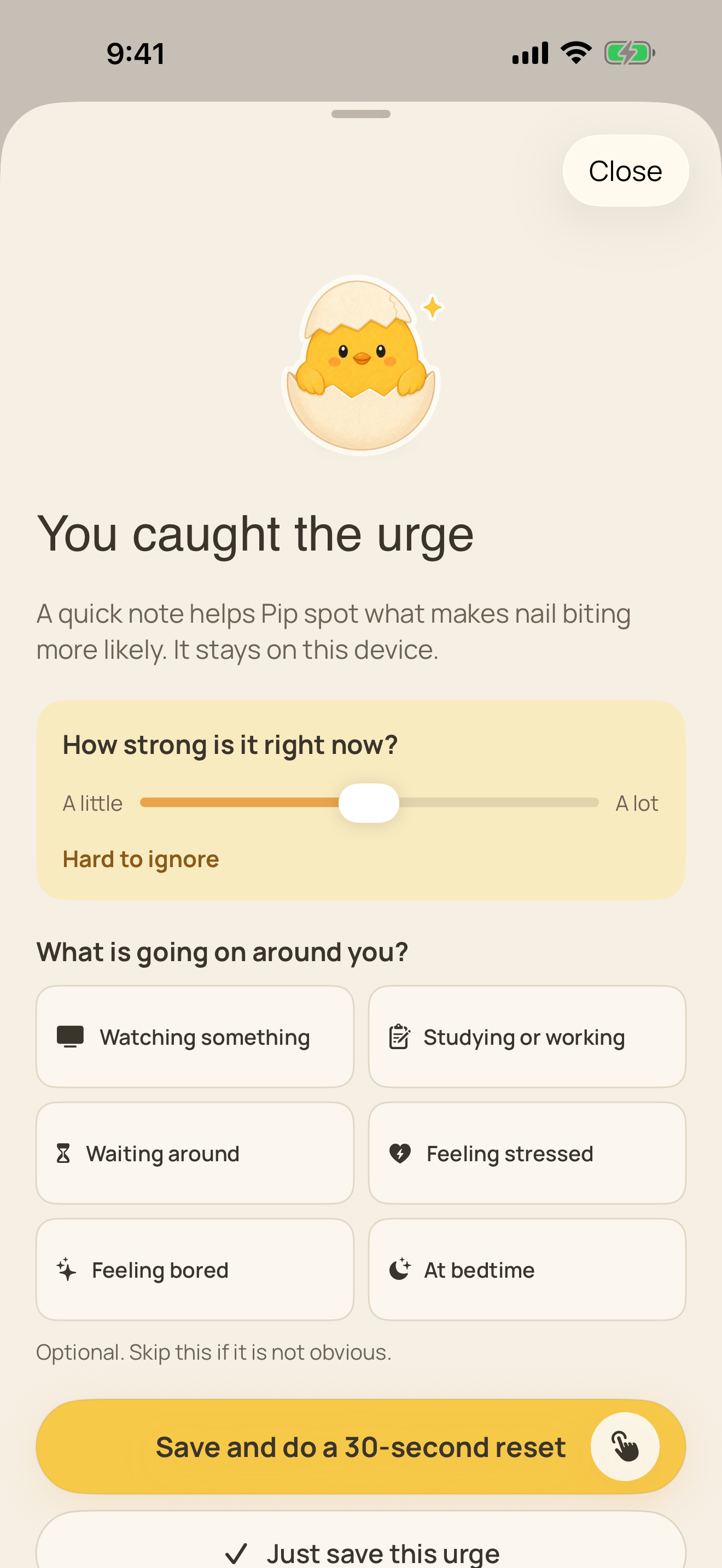
What Pipping gives you for hair pulling
- A competing-response trainer for a hand action that makes pulling hard.
- Redirect mode, which turns a movement that has already started into a different one.
- An urge surf of 90 seconds or 3 minutes, and a 10-minute delay with an I'm not doing it button.
- A one-tap I noticed afterwards log, because a lot of pulling happens without noticing.
- With Pip Plus, a private photo journal and if-then plans for your riskiest times.
Where Redirect mode comes from
Redirect is based on decoupling, a self-help method that Moritz and Rufer tested for hair pulling in 2011. You change the movement on its way to your hair rather than stopping it outright.
The competing-response trainer comes from habit reversal, described by Azrin and Nunn in 1973.
Know your risky times
Each log keeps the time, the place in your body and how strong the urge was. With Pip Plus the pattern map shows when urges cluster, and if-then plans prepare you for those moments.
When to see a doctor
- Bald patches from hair pulling, or swallowing hair.
- The habit takes hours of your day, or you feel low, anxious or hopeless.
- If you are under 18, talk with a parent, school nurse or doctor too.
Free and Plus
Everything above is free for one habit. Pip Plus adds more habits, the 12-week plan, the pattern map and more.
Pipping is self-help, not treatment. The TLC Foundation keeps information and a therapist directory for hair pulling.
Sources Moritz and Rufer, Movement decoupling for trichotillomania, 2011, Azrin and Nunn, Habit reversal, Behaviour Research and Therapy, 1973, The TLC Foundation for BFRBs.